Informed decision-making is not about being right; it is about using a disciplined process to reduce risk. Organisations operate under uncertainty, with incomplete information and shifting constraints. The aim is to test competing narratives and plausible scenarios against evidence, assumptions, and incentives, so that surprises are fewer and recovery is faster when they occur.
To do so, one should work with multiple narratives, not a single forecast. Running this exercise as a tight loop requires first framing the problem, subsequently generating narratives and scenarios, and finally testing against data and constraints to select a provisional course that preserves option value. Success is measured by risks avoided, options kept alive, and speed of adaptation, not by whether the original plan proved “correct”.
As Eisenhower observed, “Plans are useless, but planning is vital.” The artefact (the plan) can be discarded; the shared mental models, identified indicators, and rehearsed responses created by planning are what matters. By evaluating narratives and scenarios rigorously, an organisation can make decisions that fail safely and improve quickly.
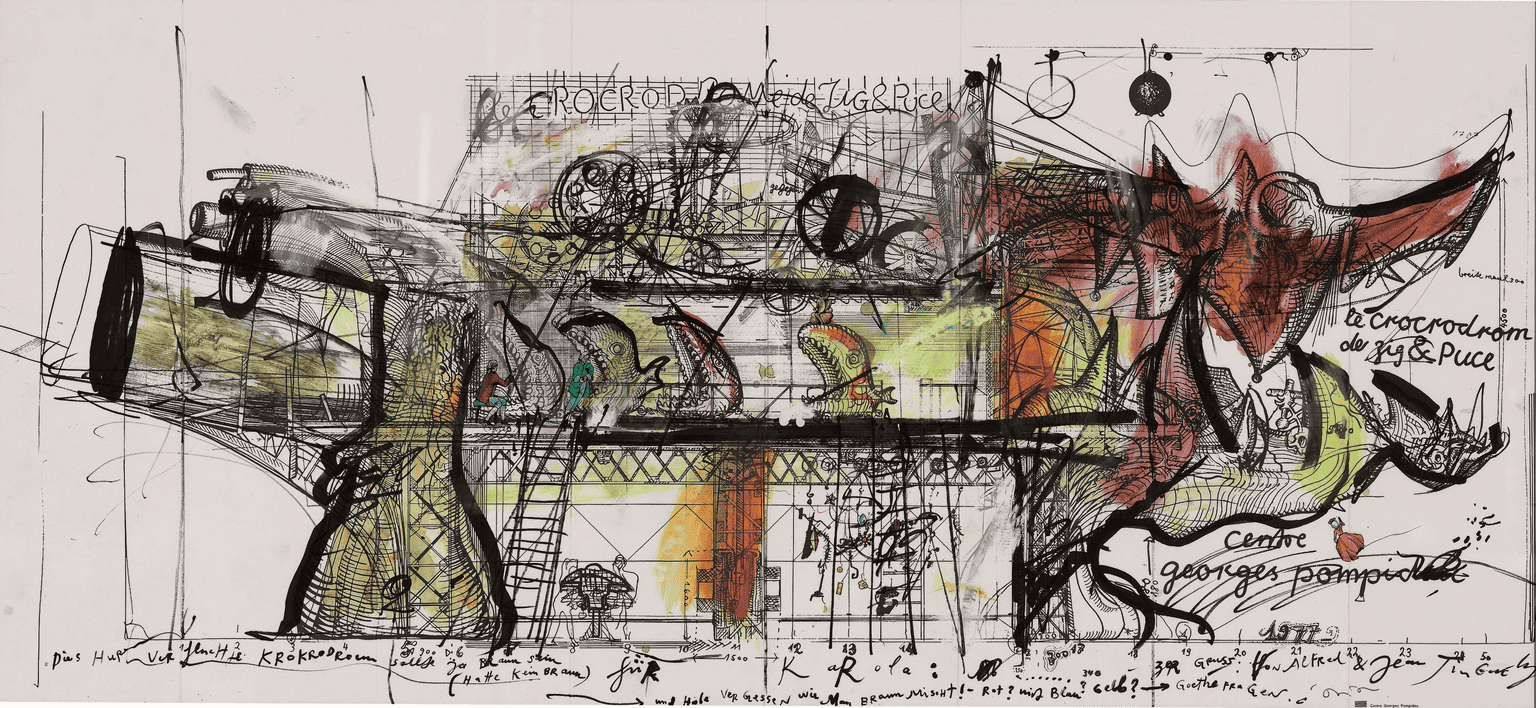
Sketch of the Crocrodrome by Jean Tinguely
The Crocrodrome by Jean Tinguely reframes the museum as a platform, not a pedestal. Value emerges through participation, not possession: an innovation model institutions still chase.
Over to you
If you treat your next big decision like a small experiment, what two or three possible stories would you test, and what quick evidence would prove each one wrong?